
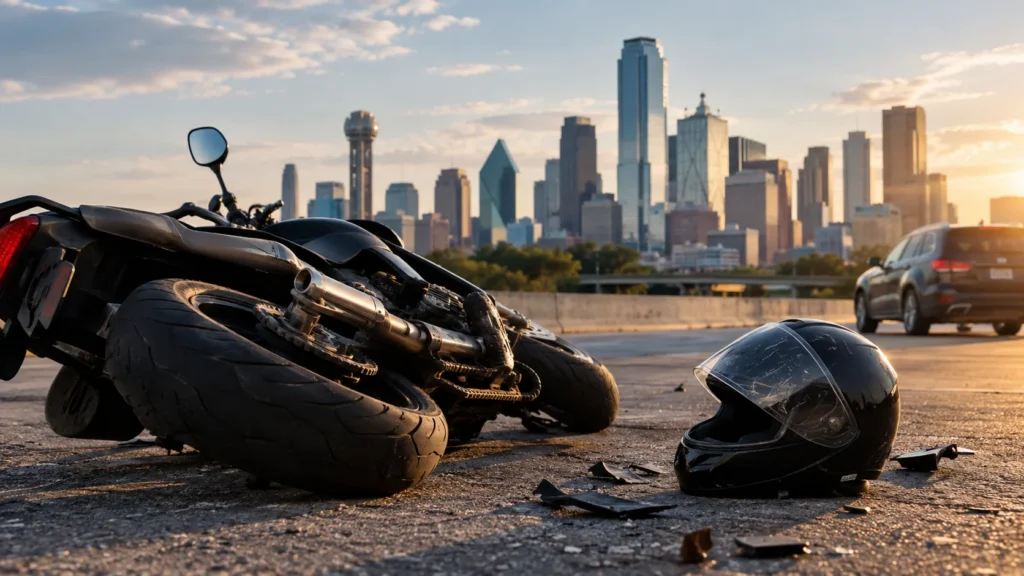
A motorcycle accident claim in Texas runs on the same negligence rules as a car crash, but in practice it is defended very differently: injuries tend to be more severe, the other side’s insurer tries more often to assign part of the blame to the rider, and one element appears that does not exist in a car crash — the helmet — which can become part of the argument. Understanding those differences from day one changes how the case is built.
What does the Texas helmet law require?
Texas law generally requires motorcycle operators and passengers to wear protective headgear that meets applicable safety standards when riding on a public street or highway. An exception may apply to riders who are at least 21 years old and who have either completed an approved motorcycle safety course or have qualifying health insurance coverage for injuries sustained in a motorcycle accident. Riders and passengers under 21 do not qualify for that exception when operating or riding on a motorcycle on a public street or highway. Whether a rider was wearing a helmet may also become relevant in a personal injury claim depending on the circumstances of the accident and the injuries involved.
Can the insurer use the helmet against me?
Possibly. Not wearing a helmet does not automatically prevent someone from bringing a motorcycle accident claim in Texas. However, the other side may argue that helmet use is relevant to the nature or extent of certain injuries. Whether that evidence can be considered, and what effect it may have on the claim depends on the specific facts, the injuries involved, and the legal issues presented. What is worth knowing is the possible consequence: Texas follows a proportionate responsibility system. If an injured person is found to be 50% or less responsible, any damages awarded may be reduced according to that percentage of responsibility. We explain how that calculation works in our guide on what an injury case is worth in Texas.
Why do insurers treat a motorcycle crash differently?
For two practical reasons. The first is severity: with no bodywork around the rider, an impact that leaves a dent in a car bumper can leave a motorcyclist with multiple fractures, road rash or a spinal injury. That means higher-value claims, and the insurer knows it from the first call.
The second is bias. There is a settled assumption that the rider was speeding, was moving between lanes, or slipped into a gap. Very often the other driver says they “didn’t see him” — a phrase that actually describes their own failure to pay attention, but which gets used as the basis for shifting blame. Anticipating that argument and dismantling it with evidence is much of the work in these cases.
What evidence decides a motorcycle claim?
In practice these are the pieces that carry the most weight, and the ones lost fastest:
- The scene. Final position of the vehicles, skid marks, debris on the pavement, signage, and sightlines. It degrades within hours.
- The police report and the identification of witnesses, particularly those who saw the moments before impact and not just the aftermath.
- The helmet and protective gear. Keep them uncleaned and unrepaired: they document the point of impact and contradict accounts of how the crash happened.
- The motorcycle itself. Do not repair it or release it to salvage before the damage has been documented.
- Video. Cameras on nearby businesses, dashcams in other vehicles, and traffic cameras. Many overwrite within days.
- The complete medical record from the very first moment, including treatment at the scene.
How long do I have to file in Texas?
In many Texas personal injury cases, the deadline to file a lawsuit is two years from the date of the accident. However, different deadlines or notice requirements may apply depending on the circumstances and the parties involved.
Even when the legal deadline is months or years away, important evidence may be lost much sooner. Video footage can be overwritten, witnesses’ memories may fade, and the motorcycle or other physical evidence may be repaired, altered, or disposed of.
Acting promptly can help preserve information that may be important to evaluating and documenting the claim. You can also read more about common issues to avoid in our guide to five mistakes after an accident in Texas.
Let's talk about your case
A motorcycle accident in North Texas should not leave you carrying costs that belong to someone else’s insurer. At The Law Offices of John R. Salazar we have handled personal injury matters since 1990, with offices in Dallas County and Tarrant County, and we assist clients in English and in Spanish. You can request a free consultation to have your situation reviewed, or read our car accident lawyers page, where we explain how we handle this type of claim.
Frequently Asked Questions
Not wearing a helmet does not by itself close the door on a claim. What can happen is that the other side tries to use it to assign you a percentage of fault, and in Texas that percentage reduces compensation. It is an argument that gets contested, and it is worth having advice before accepting any offer.
A driver failing to see a motorcycle does not relieve them of responsibility; the duty to pay attention to the road is theirs. That statement usually describes precisely the lack of care that caused the crash. What matters is documenting it and testing it against the evidence from the scene.
There may be more than one avenue of coverage depending on the case, including your own policy in certain circumstances. It is one of the first things we review in the consultation, because it shapes the whole strategy of the claim.